
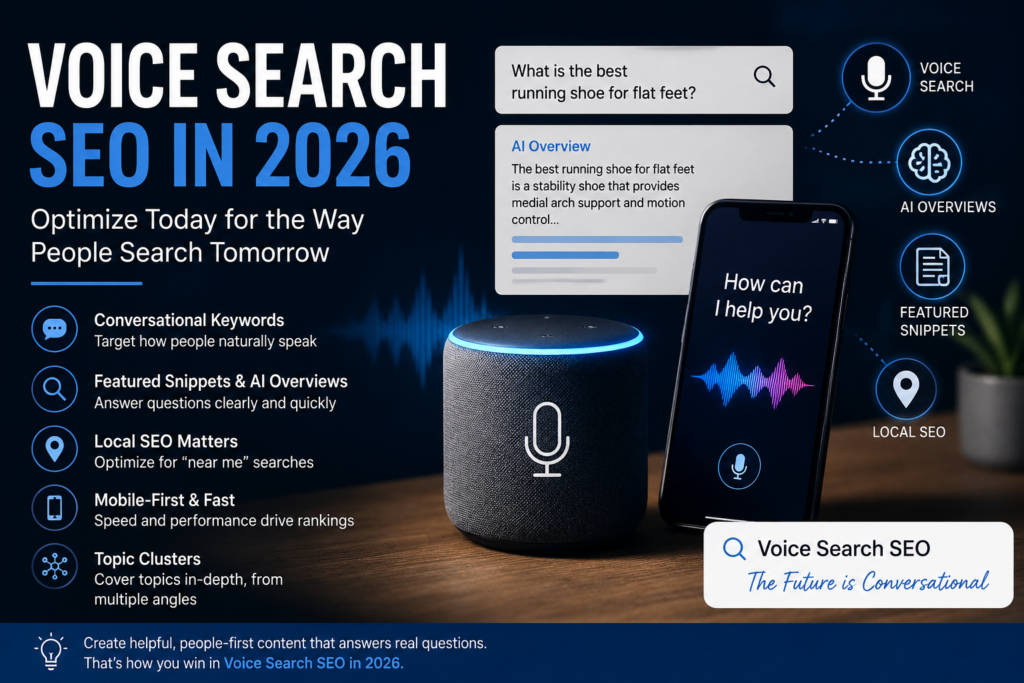
Voice Search SEO is becoming increasingly important as more people use smart speakers, smartphones, and AI assistants to search online. In this guide, you’ll learn how voice search works, why it matters in 2026, and the best strategies to optimize your website for higher rankings and better user experience.Voice search stopped being a novelty a while ago. In 2026, it’s a core part of how people find information — and the rules for showing up in those results have quietly changed.
Voice search is no longer a niche channel
The numbers make the shift hard to ignore. Voice queries now account for roughly 27% of all searches, and there are more than 8.4 billion voice-enabled devices active worldwide — smartphones, smart speakers, and cars included. In the U.S. alone, over 150 million people use voice assistants regularly.
But the bigger story isn’t the volume. It’s that voice search has quietly merged with something else: AI-powered search. Google’s AI Overviews, along with tools like ChatGPT and Perplexity, are increasingly how people get answers — spoken or typed. That convergence is reshaping what “optimizing for voice” actually means.
What’s actually changed for SEO
Conversational queries have replaced keyword fragments. People don’t say “best pizza NYC” out loud. They ask, “What’s the best pizza place near me that’s open now?” Content built around short, clipped keywords doesn’t map well to how people actually talk — long-tail, question-based phrasing is now the unit you optimize around.
Voice SEO and AI Overview optimization have merged into one strategy.This is the most important shift for anyone doing this work in 2026. Voice assistants and AI Overviews run on the same underlying mechanism: natural language processing that reads for intent, not just keyword matches. Content built for clear questions, direct answers, structure, and FAQ schema earns the same signals in both — one strategy, two channels.
Featured snippets are still the prize. Capturing the featured snippet remains a primary goal, since it’s the answer voice assistants read aloud. Answering questions directly in the first ~100 words of content improves the odds of being the one read aloud.
Local search and voice search are deeply linked. A large share of voice queries are location-based — “near me” searches for coffee, plumbers, urgent care. If your local SEO is weak, you’re invisible to a big chunk of voice traffic by default.
How to actually optimize for it the Practical steps for 2026 are :
1. Target Long-Tail, Question-Based Keywords
Focus on keywords that match how people naturally speak. Use who, what, where, when, why, and how questions instead of short keyword phrases.
Example:
- ❌ Coffee shop hours
- ✅ What time does the coffee shop open on Sundays?
2. Answer Questions Immediately
Provide the direct answer within the first few sentences, then explain the details.
Weak Opening:
Choosing the right running shoe can feel overwhelming…
Strong Opening:
The best running shoe for flat feet is a stability shoe with medial arch support. Here’s why and which models to consider.
3. Add FAQ Schema Markup
Use FAQ schema to improve visibility in voice search and AI-generated search results.
Write questions exactly as users would ask them aloud.
Example:
- ✅ Do you deliver on weekends?
- ❌ Weekend Delivery Policy
4. Strengthen Local SEO
Improve your local search presence by:
- Completing every Google Business Profile field
- Keeping your business name, address, and phone number consistent across directories
- Creating location-specific pages
- Using natural “near me” phrases where appropriate
- Responding to customer reviews regularly
5. Optimize for Mobile Speed
Most voice searches happen on mobile devices.
Improve performance by:
- Compressing images
- Reducing render-blocking scripts
- Optimizing Core Web Vitals
- Ensuring fast mobile page loading
6. Build Topic Clusters
Create a pillar page supported by related articles instead of publishing isolated content.
Example:
Pillar Page
- Guide to Running Shoes
Supporting Articles
- Best Running Shoes for Flat Feet
- Trail vs. Road Running Shoes
- How Often Should You Replace Running Shoes?
- Running Shoe Buying Guide
7. Write in Simple Language
Use clear, conversational language that is easy to understand.
Best practices:
- Keep sentences short.
- Avoid unnecessary jargon.
- Write the way people naturally speak.
8. Use Conversational Transitions
Replace formal transitions with natural spoken phrases.
Examples:
- So, how does this actually work?
- The short answer is…
- Here’s what you need to know.
- Let’s look at an example.
9. Focus on High-Intent Searches
Prioritize topics that encourage users to click for detailed information.
Great topics include:
- Comparisons
- Buying guides
- Product recommendations
- Tutorials
- Step-by-step guides
Avoid spending too much effort on simple questions (such as weather, definitions, or unit conversions) that are often answered directly in search results without generating website visits.
Don’t ignore voice commerce
Voice isn’t just for information lookups anymore — it’s becoming a sales channel. Voice-driven purchases are projected to reach 30% of total ecommerce activity by 2030, which means product pages, not just blog content, need the same conversational treatment: clear answers to “does this come in size X,” “how much is shipping,” and “is this in stock near me.” Retailers who treat voice optimization as a blog-only exercise are leaving a fast-growing channel on the table.
Common mistakes to avoid
- Stuffing question keywords into old content without restructuring it. Slapping “What is X?” as an H2 above the same dense paragraph you had before doesn’t help — the answer still needs to be short, direct, and near the top.
- Ignoring page speed. Voice results favor fast-loading pages, and a slow mobile experience will keep you out of contention no matter how well-written the content is.
- Treating local SEO as an afterthought. If you’re a local business and your Google Business Profile is incomplete or your NAP (name, address, phone) is inconsistent across the web, you’re losing “near me” voice traffic before the content even matters.
- Writing FAQ schema for search engines instead of people. Schema markup should reflect real questions your customers actually ask, not keyword-stuffed variations that read awkwardly out loud.
- Optimizing for voice and AI Overviews as separate projects. Splitting these into two workstreams wastes effort — the same content structure serves both.
How to measure whether it’s working
Voice search doesn’t show up in analytics as a clean “voice” channel, so track proxies instead:
- Featured snippet and AI Overview appearances for your target questions (rank tracking tools increasingly report these).
- Organic traffic to question-based, long-tail pages specifically, rather than head-term pages.
- Local pack visibility for “near me” and location-qualified queries.
- On-page engagement (time on page, bounce rate) for content restructured around direct-answer formatting — a rise here usually signals the content is serving both human readers and AI systems well.
The takeaway
Voice search SEO in 2026 isn’t a separate discipline anymore — it’s converged with AI Overview optimization into one connected strategy. The businesses winning this space aren’t the ones bolting question keywords onto old content. They’re the ones rebuilding around clear, conversational, directly-answered content that works whether the “search” is typed, spoken, or asked of an AI assistant.